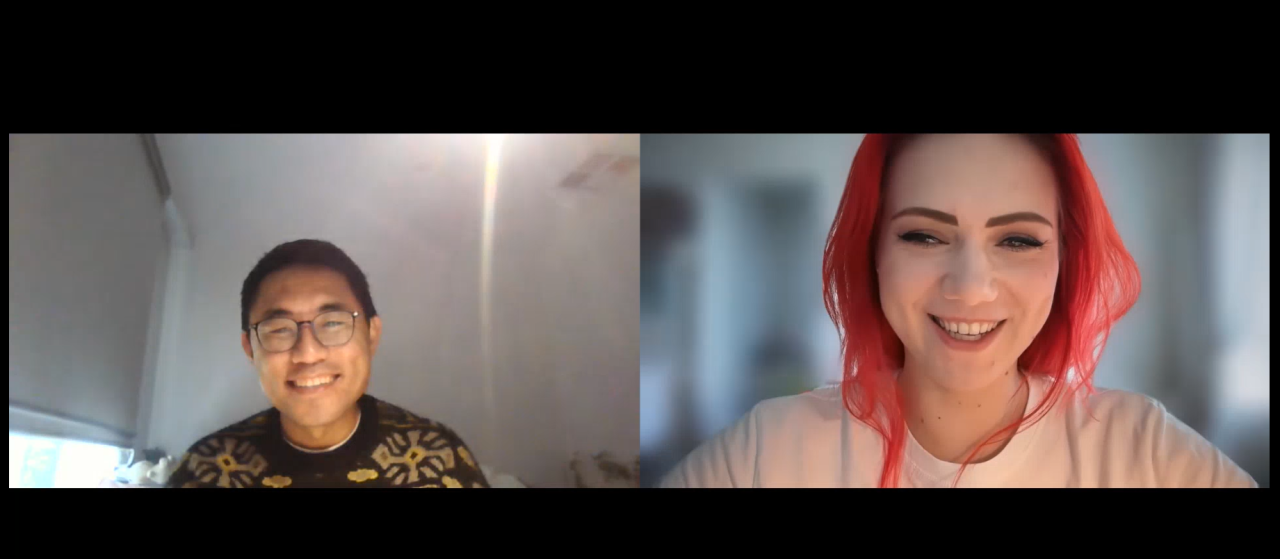
There is a version of this story that writes itself in ten seconds. A European woman moves to Beijing, works for a Chinese gaming company, finds it different, survives.
That version is accurate and completely useless.
The more honest version begins with Nataliya Ivakhina sitting at a hot pot table in her first week at a new job, in a new city, in a new country, surrounded by colleagues she doesn't yet know, staring at a napkin she has just been handed, having briefly forgotten how to be a human being.
"I literally froze. I forgot how to use chopsticks. I forgot how to mix the sauce. I was thinking: there is working culture happening around this table, there is my boss here, there is the correct way to hold a conversation and the correct way to eat this food, and I cannot access any of it. I think I ate maybe several pieces of meat the entire lunch."
It's the kind of moment that, in retrospect, tells you everything. Not because Nataliya is incompetent — she is, by every measure, the opposite of that — but because it reveals what actually happens when a high-functioning, highly experienced professional steps into a system that does not share a single operating assumption with anything she has ever known. The brain overloads. The basics dissolve. You find yourself wondering, mid-hot pot, whether you remember how to eat.
She has a name for this feeling now, arrived at after eighteen months of working, failing, adjusting, and transforming inside a Beijing gaming company. She describes it as being like a newborn baby: knowing nothing, unable to do the simplest things, but — crucially — surrounded by a family that is patient and willing to teach.
"If you think you are a professional and know many things," she says, with a dry smile, "well. Come to China."
What happened in those eighteen months is what this conversation is really about.
Four Cities, One Direction
To understand how Nataliya ended up in Beijing, you have to start somewhere else entirely. She was born in London to Russian parents, grew up in Moscow through her formative years, and by the time she was considering what to do after her undergraduate degree, she had already lived in two countries and two cultures without ever quite choosing them. Edinburgh was the first place she chose for herself.
"It was the first big decision in my life that I made," she says. "My parents inspired me — why not study abroad? — but the choice was mine."
She went to Scotland to do a master's in Event and Festival Management, a discipline that sounds niche until she explains it, and then sounds almost inevitable. Edinburgh is, as she puts it, a festival city. It doesn't just host events; it practically exhales them. For a student who wanted not just theory but doing, the city was a live practicum that never stopped. She worked across different events in different roles, found herself inside an international cohort, and discovered something she has since applied twice more: that the discomfort of going somewhere strange and starting from nothing is not a reason to stay home. It is the whole point.
"Even if it feels scary, just go do it," she says. "You will be rewarded."
She has now applied this logic to three major moves. Each time, it has been correct.
The move to Beijing, though, was different in one respect: it was, in her words, "an accident that very quickly turned into a calculated step." A manager from a gaming company reached out to her on LinkedIn in 2024 with an on-site position in Beijing. She was open to the conversation. She went on a call. And then something clicked.
"Asian job market was my target for a couple of years already," she says. "But I still needed to gain more experience before I could enter it. So when this company came to me, I knew very quickly that this was a unique opportunity I couldn't miss."
The accident had been in her plans all along. She just hadn't written it down yet.
What a Week in Beijing Actually Looks Like
When I ask her to describe her typical workweek, she pauses in a way that suggests the word "typical" doesn't quite apply.
She is Senior Creative Producer in mobile games. The days are dense. Meetings, scripts, creative reviews — the workload is, in her word, "intense." But she talks about the structure with a kind of affectionate respect rather than complaint. One detail stands out: the lunch break.
"We have an hour and a half break," she says, as though sharing something slightly miraculous. "You can actually have a life in the middle of the day."
For someone accustomed to the squeeze-the-sandwich-at-your-desk rhythms of European offices, this genuinely surprised her. She uses the time for language studies, or to read, or simply to grab a coffee with a colleague without the guilt of the clock. The middle of the day is not dead time. It is hers.
After work, there is always something: gym, extra study, family calls. Weekends, she has made a rule for herself — always something new in Beijing or around it. A temple. An unexplored corner of the city. A day trip somewhere she hasn't been.
"You can still be a tourist here," she says. "It doesn't become just work-home-work. There is still this feeling of traveling."
She is also, in her spare time, learning two languages simultaneously. She resumed Japanese, which she had been studying for three years before the move disrupted the habit. And she started Mandarin from zero, which she describes with the equanimity of someone who has accepted that certain challenges are simply long.
"It's extremely hard," she says. "My progress is slow. But it's fascinating."
The Hot Pot Baptism
Back to that first week.
The hot pot invitation was, as I explain to her, almost certainly an act of welcome — in Chinese culture, particularly in Sichuan tradition from which hot pot originates, sharing the same pot is intimate. It's family food. You don't invite strangers to hot pot. You invite people you are close to, or people you want to become close to.
Nataliya's new team was, in their way, wrapping her in the warmest possible greeting. She was just too overstimulated to receive it.
"There were so many things going on at once," she says. "The ordering, the ingredients, the sauce station, the social dynamics, my boss sitting there, the working culture expectations I didn't know yet — my brain was just completely full."
What saved her was the team's instinctive warmth. They didn't wait for her to figure it out. They showed her. Try this sauce with this. Take it from here. No ceremony, no embarrassment on either side. Just humans helping a new human eat dinner.
"They taught me how to do it," she says. "And then the frozen feeling passed, and I was like: okay. It's just food. You remember how to eat."
She pauses. "That hot pot was really tasty."
She now takes her own visitors to hot pot. She runs the whole process — ordering, sauce mixing, the works. The frozen woman at the table has become the guide.
When Your Playbook Doesn't Work Here
Nataliya is a Senior Creative Producer specializing in User Acquisition — the discipline of making videos, images, and playable ads that convince people to download mobile games. She is good at it. She came in with a production method that had worked beautifully everywhere she'd been before: build genuine collaboration with your in-house creative team by inviting them into the decision-making. Don't just tell an artist what you want. Let them own the parts they know better than you. Colour combinations. Texture choices. Animation effects.
The thinking was: people make better work when they care about it, and they care about it more when they made some of it themselves.
"So when I joined my new Chinese company, I tried the same approach," she says. "I gave the brief, the core idea — and I asked them: what furniture should we use here, what colours, what do you think?"
Nothing happened.
She tried again. Still nothing. A few more attempts. And then she began to sense something she couldn't quite name: a growing tension. Not hostility — nothing so dramatic — but a gathering weight in the space between her and the team that told her something was wrong.
"I talked to the PM manager and HR," she says. "And they explained: the structure here is different. These are high-quality professionals, but they're working across all the company's projects simultaneously. They physically can't take this part of work from me."
What she had read as passivity or disengagement was actually a simple resource reality: the team was stretched across multiple projects, and asking them to also propose creative variants was not empowering them. It was adding pressure to a pile that was already high.
"So the correct approach here is: I decide. I say, I want this set of furniture, this colour. Or: I don't care about the wall colour, choose whatever you like, I won't comment on that."
This is one of the cleanest examples of a Western management instinct — inspire ownership, distribute decision-making — colliding with a structure that cannot accommodate it without creating friction. It was not a values conflict. It was not a cultural incompatibility at the level of people. It was an architectural mismatch: two systems, both functional in their own contexts, briefly running against each other.
The near-miss was resolved through conversation. Nataliya felt the tension building, named it early, sought to understand it rather than push through it, and adjusted.
"I didn't take it to conflict," she says. "It was more: guys, I did this, please give me feedback. And they gave me feedback. It became about adjusting to a new structure."
The Colleague Who Became More Than a Colleague
Not all of Nataliya's relationships in China started with warmth and ended with warmth. One of the more honest things she says during our conversation is that her first real working relationship at the company started cold.
The person was her supervisor and something like a manager: a Chinese woman, whose English was good, but who hadn't spoken it regularly since coming back. Into this woman's lap dropped: one new colleague, red-haired, tall, European, speaking only English, needing significant hand-holding.
"We were both under stress," Nataliya says. "Me from my side, navigating everything new. Her from her side, having this foreigner as a direct charge when she hadn't practiced her English in years. I can't say we were enemies. But we started with real distance. A cold environment."
They made a decision that turned everything. After an initial misunderstanding — the details don't matter — they agreed to be honest with each other. Radically, explicitly honest.
"We said: let's be very open with each other. If you feel uncomfortable, tell me. And we started to actually do it."
The feedback loop became the foundation of this specific relationship, between these specific two people, because both of them chose it.
Then they went on business trips together. Shanghai, among others — a city where her colleague had once lived and which she returned to with the warmth of someone visiting a happy place. Off the clock, out of the office, negotiating taxis and restaurants and plane delays side by side, something shifted.
"Step by step, we started to support each other. To listen. To defend each other when needed. To share things."
When her colleague eventually left the company, Nataliya describes it as "a small tragedy." But they are still in contact. They met for coffee the week before our conversation.
"I see the whole path we made," she says. "We really transformed that relationship."
It is, in miniature, a blueprint for something that people spend considerable money on consultants to teach: that trust between people from different cultures is not automatic, is not impossible, and is built through exactly the unglamorous actions Nataliya describes. Explicit agreements to be honest. Following through on them. Shared experiences outside the normal context. Patience with misunderstanding. And the courage to say I feel uncomfortable when you actually feel uncomfortable.
The Thing Nobody Else Thought to Do
Event and festival management is not the most obvious background for a career in mobile gaming. But here is what it gave Nataliya: the ability to turn chaos into structure. To look at a room full of people with different functions and different ideas and build a process that lets them actually think together, not just beside each other.
When she arrived at the company, she noticed something she says is common across gaming companies regardless of culture: the creative producers were isolated. Each person in their own silo, generating ideas alone, stuck — and not saying they were stuck.
"Everyone was suffering," she says. "But no one was saying anything."
On a business trip to Shanghai, she proposed something she had never seen done at this company before: a structured brainstorming session. Her terms were simple. Let me guide you through this. I will prepare everything. You just come.
She prepared everything. The board. The schedule. The time slots. The room. Advance information so no one arrived cold. She ran it as a proper facilitated event — because that, it turns out, is exactly what her master's degree had trained her for, a decade earlier in Edinburgh.
"People relaxed," she says. "And they started to come up with really brilliant and interesting ideas."
Productivity aside, the session served a second function: it created a space where the team could surface what wasn't working. A follow-up meeting focused entirely on process. What is broken? What isn't reaching us? What should we change?
Several real problems were identified. They were brought to leadership. Changes were made.
"I acted as a producer on one side — helping with creative strategy and structure," she says. "But also as a manager who is good at helping people say out loud what is not working."
Her team still calls her the "board master." The brainstorming sessions are still happening.
The Biggest Mistake
I ask her directly: what was your biggest mistake?
She does not hesitate.
"Coming here expecting things to be the same."
She is not describing naivety about the food or the language or the social customs. She is describing something more fundamental: a cognitive assumption so deep she hadn't noticed she was making it. She expected the company, the workflows, the professional structures, the rhythms of decision-making — to be familiar. Differently named, perhaps. But familiar in architecture.
They were not.
"And switching out of that mode was really hard," she says. "At the beginning, I was constantly uncomfortable. I was looking for the system. Where is the system? Where are the same things that exist in every company I've ever been in?"
When she couldn't find them, she started pushing. Bringing her previous experience in as recommendations. Pointing to how things could be done differently.
"But I felt very quickly that this was not needed. I was not invited here to change the system. I was invited to bring my experience into the system."
She made a decision that she credits with saving her from something worse than discomfort: she stopped pushing and started watching.
For the first six months, she observed. How do people think here? What do they value? How do decisions actually get made, day to day? What is working, and why is it working?
"I started to see good things in this system. Good points in these attitudes and ways of working. Things that were actually effective."
And then she began the more interesting project: mixing. Taking what was working from the Chinese approach — the speed, the directness of execution, the capacity to move without over-strategizing — and integrating it with what she brought. Building something that was neither fully hers nor fully the company's, but a synthesis that was only possible because she had been willing to be changed.
"The biggest mistake was really not being prepared for changes," she says. "And for a different culture. I know that sounds simple. But it's the one thing I really wish I had understood before I arrived."
Speed Is Not Chaos. Strategy Is Not Virtue.
One of the more surprising things Nataliya says is about pace.
In European companies, she describes a familiar rhythm: structure first, define the hypotheses, clarify success metrics, consider which mistakes are acceptable — and then move. The value placed on rigour is high. The threshold for action is correspondingly high.
"Here, people start doing it. They start to accumulate data. They make adjustment decisions. They are okay with making mistakes and learning from them. They're already moving."
She says this not as a criticism of either approach but as a description of a genuine difference — one that initially made her uncomfortable and that she now, after eighteen months, partly admires.
There is a version of slow strategic thinking that is wisdom. And there is a version that is anxiety dressed as rigour — the compulsion to make every decision defensible before you make it, at the cost of the learning that only happens in action. Watching her Chinese colleagues move at a pace she initially found alarming, she started to wonder which version she had been practicing.
996? Not Here.
When Nataliya told her friends and former colleagues she was moving to China to work for a Chinese gaming company, one reaction was nearly universal: you're going to be working every hour of your life.
"That's a stereotype that definitely exists abroad," she says.
And there are companies in China — famously — where it is not just a stereotype. The 996 schedule, 9am to 9pm six days a week, became a cultural flashpoint for a reason. It is or was real, in certain industries, at certain companies. Nataliya knows this.
But it is not her experience.
Her company tracks overtime. They provide corporate taxis for employees who stay late. HR noticed when Nataliya was working long hours in her early months — partly because she had to do everything twice, write in English, translate to Chinese, verify the Chinese — and came to check on her.
"She said: Nataliya, I see you are always staying late. Is everything fine? Is the workload too big? How can we help?"
Her colleagues model work-life balance in the simplest possible way: they arrive focused, they work hard, and they leave when their shift ends. Her boss does the same.
"It's not about staying in the office until the boss leaves," she says. "That's just not in this company at all."
She thinks this is partly genuine top-management philosophy — burnt out people do not perform — and partly a competitive advantage in a talent market where many professionals are actively looking for somewhere that treats them like adults with lives.
"People who left our company and joined other companies tell me: your company was really great. They actually think about mental health and work-life balance."
This is, perhaps, the data point that most surprises people who carry the 996 assumption into conversations about working in China. The generalization serves no one. The reality, like most realities, is more specific than the headline.
The Language Wall
Twenty percent. That is roughly how many people in Nataliya's office can communicate with her in English at a working level. In her immediate team, the number is lower still.
She arrived with zero Mandarin. She works in a Chinese company, in Beijing, doing her job almost entirely in a language she is still learning, with translation assistance for everything she writes and a support team she can bring to meetings when needed.
She does not present this as a solved problem. But she has a framework for thinking about it that is worth pausing on.
"When a company makes the decision to hire a foreigner, ideally they should understand that this challenge comes with that decision. And be willing to work on it together."
Her company has done their half of the work: an on-site translation team, AI tools, people willing to check her Chinese writing, a culture of patience with the additional time things take. Her half involved learning something that sounds simple but is not: how to write plain English.
Not her natural English — which is conversational, varied, flexible — but a deliberately simplified version designed to survive machine translation. Short sentences. Direct information. No idioms. No complex structures.
"So that when the AI translates it, what comes out on the other side is still what I meant."
She also quickly discovered the limits of AI translation in real-time settings. Systems that can handle written text collapse in live conversation: multiple voices, overlapping speech, accents, the natural speed of a real exchange. The translation lags, gets confused, and by the time it catches up, the meaning has mutated.
"Translators can get the main idea of a conversation and carry it across. AI tries to translate every word and sentence, and it falls apart."
The hardest moment was not at work at all. It was in her apartment, dealing with a maintenance problem, trying to explain a complex chain of events through WeChat's translation function to someone who didn't speak English. The problem was literally in the room, visible and unresolved, while she typed and re-typed.
"I decided to write everything very simply," she says. "And the person was patient. He read everything. He understood. He fixed it."
Patient. It is a word she uses more than any other. She has earned it.
What Changes When You Change
I ask her what has changed in her — not just in her approach to work, but in how she thinks.
"I definitely started to act and react faster," she says. "I'm trying not to spend ages thinking and making decisions."
The strategic perfectionist instinct — which had served her well in European contexts — she has deliberately loosened. Not abandoned, but loosened. She allows herself to be less certain before moving. She has learned that the cost of a wrong move made quickly is often lower than the cost of the paralysis that comes from waiting to be right.
She has also become more patient, which she names alongside the faster pace without seeing any contradiction. The two coexist: speed in decision, patience with people.
"Because of all the misunderstandings and translation issues, you really need to be calm and accurate and polite," she says. "You cannot afford to be sharp or impatient — it just breaks things."
She describes the transformation as still in progress. She is not sure she can fully see its shape from inside it.
"I maybe don't fully understand yet how I've changed. But I know I have. Firstly in how I think and how I make decisions. That is the main change."
"It's a rollercoaster with very rough ups and downs. You don't always know which direction you're moving. But you're moving."
Her Husband, the Accidental Chinese Linguist
Nataliya did not move to Beijing alone. Her husband came with her, and she describes him, with evident warmth, as her "hero who joined me in this journey."
He does not have a regular office job, which means his social integration happened more slowly and more haphazardly than hers. He found his way, but it took longer.
And then something unexpected happened. He started learning Chinese — and turned out to be extraordinarily good at it.
His teachers are a mismatched pair: a Russian-speaking woman on one side, a Chinese man who speaks neither English nor Russian on the other. With the Russian-speaking teacher, he can negotiate. With the Chinese teacher, he cannot. Both of them are, as Nataliya puts it, "forced to find a way to communicate in Chinese." So his spoken Chinese improved quickly, out of sheer necessity. Add to this the total immersion of Beijing life — ads, conversations, videos, signs — and within months, he was reading the street.
"He was walking down the street and reading things out loud," Nataliya says. "The alcohol shop. The bakery. The meat shop. I was like: how are you doing this? I'm suffering with Japanese kanji and you're reading Chinese signs after a few months."
She is clearly both amused and a little jealous. But more than that, she is relieved. She had been anxious about how he would settle in, whether he would be okay, whether the move would cost him more than it gave him.
"Seeing that he not only progresses quickly but likes it — it makes me feel happy."
What She Would Have Wanted to Know
If she could go back and tell herself one thing before she boarded the plane to Beijing — not a principle, not a framework, just a specific thing that would have saved her time — what would it be?
She answers without much pause.
"Be prepared that things are very different. No details. Just: consider that you are starting from zero. It will feel like starting from zero. And it will not be like you are used to."
Not a map of the culture. Not a reading list. Not a list of do's and don'ts. Just permission — or rather, preparation — to be a beginner.
"If I had at least known that," she says, "I would have been more prepared mentally. For everything."
There is something worth sitting with here. We tend to prepare people for abroad by giving them information: here is what Chinese people value, here is how meetings work, here is how to exchange business cards. Information is useful. But it doesn't prepare you for the feeling of total competence dissolving. It doesn't tell you: the ground is going to move under your feet and you are going to forget basic things like how to eat lunch. It doesn't validate that this is normal.
What Nataliya is describing is not cultural intelligence as a body of knowledge. It is cultural intelligence as a posture — specifically, the posture of someone who has accepted they are a beginner, and who is therefore able to learn.
Would She Do It Again?
Yes.
She says it before I have quite finished asking.
"Immediately. I would do it again."
The decision to come to China was not easy. She turned it over for a long time, second-guessing herself, listing the risks. Then one morning, walking her dog, she did a simple thought experiment: if I say no, what do I feel?
Regret.
"And my mind said: then you should do it."
Once the decision was made, the fear didn't disappear — but it changed texture. It became the fear of someone who has decided, rather than the fear of someone who is still weighing. And then it became, step by step, this.
"It's still hard," she says. "It's the biggest challenge of my life so far. But it is so worth it. Not only because of the experience, but because of the people I met, the things I learned, and the transformation that is still happening."
Still happening. She says this with the equanimity of someone who has made peace with incompleteness — with the idea that she is not yet who she will be at the end of this chapter, and that this is fine, actually. This is the whole point.
After we wrap the interview, I mention to Nataliya that the companies I find most interesting to speak with are not just the foreign professionals who came to work in China — but the Chinese companies themselves, the ones who made the decision to hire internationally and had to figure out what that actually meant. She promises to think about whether someone from her company might be willing to speak.
I hope they will. Because the other side of Nataliya's story — the story of a gaming company that instinctively sends HR to check on a foreign employee working late, that tracks overtime, that builds an infrastructure so a Senior Creative Producer can do her job well in a language she is still learning — is also worth telling.
The companies are figuring it out too. Quietly, case by case, colleague by colleague.
That's how most things get figured out.